
The Towel on the Chair: A Symbol of Status in India - MSMN News
Follow MSMN
Official channels from Martins Studio Media Network.
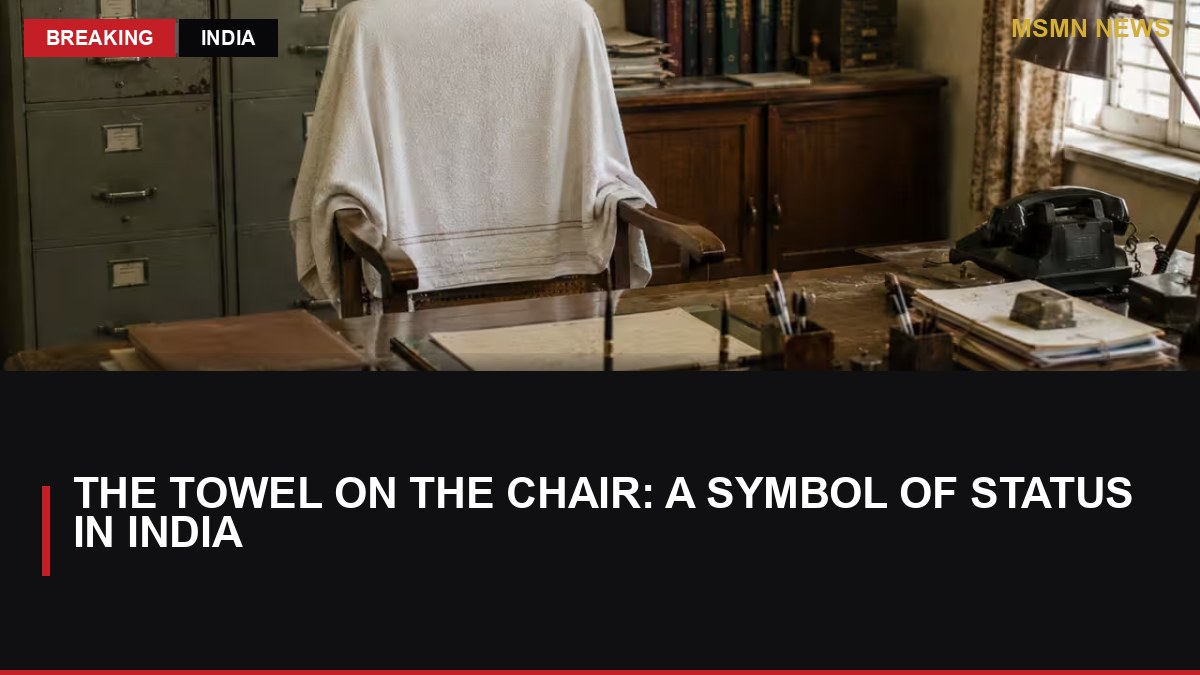
In India, the simple act of placing a towel on a chair has evolved into a powerful status symbol, reflecting social hierarchies and personal pride.
- Reviving Heritage Wheat: A Farmer's Journey to Biodiversity on His Cotswold Farm: MSMN News
- Live Q&A with Luke Harding: Insights from the Frontlines of Global Conflict - MSMN News
- Regulation Crypto is here: State of Crypto: MSMN News
- Germany’s AfD eyes Saxony-Anhalt win as first step toward federal power: MSMN News
- Louth Leads Ireland in Social Housing Deliveries: MSMN News
The Emergence of a Status Symbol
In the bustling urban landscape of India, the towel has transformed from a mundane household item into a potent symbol of status and privilege. This phenomenon, which might seem trivial at first glance, reveals deeper layers of social dynamics and cultural significance. The towel, often seen draped over a chair in Public Spaces, has become a way for individuals to assert their presence and claim a sense of belonging in a society that is constantly negotiating class and status.
The trend has gained traction particularly in crowded urban centers where space is at a premium. In cafes, restaurants, and even public transportation, it is not uncommon to see an individual place a towel on a chair, signifying that the seat is reserved for them or someone they’re with. This behavior is not merely about saving a spot; it’s about making a statement.
Social Dynamics at Play
The act of placing a towel on a chair can be traced back to various cultural practices in India. Traditionally, certain items have been imbued with meanings that extend beyond their practical uses. The towel, often associated with cleanliness and personal grooming, has taken on a new role as a marker of Social Status. It represents a level of comfort and assurance that comes from having the means to claim space in a crowded environment.
In many cases, the individuals who engage in this practice are often from middle to upper-middle-class backgrounds. They may feel a sense of entitlement to public spaces, which can sometimes lead to friction with others who do not share the same privileges. This dynamic reflects the broader societal issues of class and access in India, where economic disparities can be stark.
Public Spaces and Personal Identity
Public spaces in India are often a melting pot of cultures, classes, and backgrounds. The way individuals interact within these spaces can reveal much about their identities and the social hierarchies that govern them. The towel on the chair serves as a visual cue, indicating not only the presence of an individual but also their status within that space.
For many, the towel is a simple fabric; for others, it is a badge of honor. The act of placing it down can be a subtle assertion of one’s identity, a way to signal to others that they belong. In a society where social mobility is often a goal, these small acts can have significant implications for how individuals perceive themselves and are perceived by others.
Historical Context
Historically, India has seen various forms of social stratification, from the caste system to economic class divisions. Over time, certain behaviors have evolved as indicators of status. The practice of using a towel as a marker for personal space can be seen as a modern manifestation of these historical trends, adapting to contemporary social norms while still reflecting underlying cultural values.
The towel itself, often a simple cotton or terry cloth item, may carry different meanings depending on its color, size, and even the way it is displayed. A brightly colored towel might suggest a more flamboyant personality, while a plain white towel could signify a more subdued approach. Each choice reflects personal taste and, indirectly, social status.
The Digital Age and Social Commentary
With the advent of social media, the conversation surrounding status symbols in India has expanded. Platforms like Instagram and Twitter have allowed users to showcase their lifestyles, including the small details that signify wealth or privilege. The towel on the chair is no exception; it has made its way into the digital narrative as a symbol of the aspirational lifestyle that many seek to portray.
Influencers and celebrities often use social media to highlight their experiences in upscale cafes or exclusive events, where the presence of a towel on a chair becomes part of the visual storytelling. As a result, this seemingly innocuous act has been elevated to a new level of significance, prompting discussions around class, privilege, and the performance of identity in public and private spaces.
Reactions from the Public
Reactions to this trend vary widely among the public. For some, the towel on the chair is simply an annoyance, a sign of entitlement that clashes with the communal nature of public spaces. Others view it as a harmless quirk of modern life, an adaptation to the realities of urban living.
Critics argue that the practice highlights the growing divide between classes in India, where the ability to claim space in public areas is often tied to one’s socio-economic status. Supporters, on the other hand, might argue that it is a form of self-expression, a way for individuals to carve out their own space in an increasingly crowded world.
Future Implications
As cities continue to grow and evolve, the significance of the towel on the chair may also change. Urban planners and sociologists are increasingly interested in how public spaces are utilized and how social dynamics play out in these environments. The towel could become a focal point for discussions about access, privilege, and the design of inclusive spaces that cater to a diverse population.
The ongoing dialogue surrounding this trend serves as a reminder of the complexities of social interactions in India. As the nation grapples with rapid urbanization and economic shifts, symbols like the towel on the chair will likely continue to spark conversations about identity, belonging, and the nuances of status.
In conclusion, the towel on the chair is more than just a piece of fabric; it is a reflection of the social fabric of India itself. As individuals navigate their places within public spaces, small acts like this can carry significant weight, revealing much about the interplay of class, identity, and cultural values in contemporary Indian society. The future may see this trend evolve further, but its roots in the social hierarchy will likely remain intact, prompting ongoing discussions about the nature of status in an ever-changing world.
Source / Reference
Reporting by MSMN News, based on publicly available source material.
Source: Times of India
Reference link: https://timesofindia.indiatimes.com/india/side-lower-berth-the-towel-on-the-chair-of-sunil-ji/articleshow/132805245.cms
Recommended products
 -43%
-43%
Poshmark
I Stand With Israel T-Shirt, Israel Shirt, Pray For Israel, Jewish Pride, Israel
Approx. USD 26.00
46.00
Final price on merchant site
 -50%
-50%
OnBuy.com
Travel Blender, Portable Blender, Blender Bottle, Mini Blender, Beverage Blender, Electric Blender Bottle, Small Blender
Approx. GBP 32.80
65.60
Final price on merchant site
 -33%
-33%
OnBuy EU
Travel Blender, Portable Blender, , Blender, Beverage Blender, Electric , Small Blender
Approx. DKK 412.63
618.95
Final price on merchant site
4 merchants
Affiliate disclosure: MSMN may earn from qualifying purchases. Prices and availability may change.


Comments